English class inequality
The Man Who LaughsEnglish class inequality in the novel is a social order in which the wealth and authority of the few rest beside the hunger, insecurity, and constrained lives of the many. Its force appears both in the contrast between aristocratic abundance and ordinary deprivation and in the institutions that make this contrast seem legitimate. Gwynplaine first reads that order among the poor who come to see him; later, in the House of Lords, he tries to make its consequences visible to those who benefit from it.
Wealth, property, and inherited privilege
The contrast is announced through a written account headed as a form of satisfaction for people who have nothing. It sets that claim against Henry Auverquerque, Earl of Grantham, whose income is given as one hundred thousand a year. His marble palace is celebrated for a labyrinth of corridors, each distinguished by costly stone and color, including a corridor of many colors called the courtiers’ corridor. The inventory makes luxury concrete: abundance appears not as an abstract privilege but as an elaborate space built for the comfort and display of one household, set against the needs of those without resources.
Ursus explains aristocratic status to Gwynplaine as a power that protects its holders from disadvantages that would limit other people. A lord may enjoy deference, education, command, or the fruits of labor without having earned each advantage through personal merit. The point is not that every lord possesses every failing Ursus lists, but that rank cushions its possessor from the consequences that would ordinarily follow. In this account, privilege is inherited and socially recognized before it is individually justified.
Property and law give that rank material force. Ursus invokes the Domesday Book, compiled under William the Conqueror as a register of estates, as evidence of who owns England. He recalls having served a lord with an annual income of thirty-six thousand and contrasts the abundance of a great estate’s rabbit warrens with the punishment of a poor poacher. A father of six, he says, was executed for taking rabbits. The disparity is especially stark because the game of a powerful landowner could have supplied food to the poor of the Cinque Ports, while the law protected ownership even when hunger pressed against it. The comparison makes property enforcement a question of whose needs count.
Poverty among the Green Box audience
The Green Box attracts people because its prices are low. Its spectators are described as weak, poor, and socially small; they come seeking a pennyworth of forgetfulness. From his platform, Gwynplaine sees a crowd that changes face from evening to evening but repeatedly reveals the same kinds of distress. The performance offers a brief escape, yet the audience’s presence also exposes how little relief their ordinary lives provide.
He reads deprivation in particular faces and circumstances. Children appear underfed; workers have the capacity and desire to work but lack employment; families seem close to ruin. Some faces suggest goodness worn down into hostility by social pressure, while old age bears the mark of starvation. The crowd also includes soldiers and wounded pensioners, bringing the consequences of war into the same field of poverty. Gwynplaine sees not isolated misfortunes but recurring patterns: want of work, dependence, and people pushed toward a diminished existence by pressures they did not choose.
His view widens from individuals to a whole social landscape. He imagines families consumed by social conditions, poverty further reduced by taxes, intelligence lost through ignorance, and efforts to survive overwhelmed by hunger, exhaustion, and death. The account does not treat hardship as a single spectacular crisis. It accumulates through unemployment, deprivation, penalties, and the weakening of family and moral life. Against this mass of suffering, Gwynplaine and Dea possess a small, sheltered happiness. He sees their refuge as lying between those who trample and those who are trampled, not as evidence that the surrounding misery has disappeared.
Gwynplaine’s position between spectacle and witness
Gwynplaine’s own face makes the social contrast personal. His body is otherwise well formed, but his face bears a permanent, artificial-looking expression of laughter, the result of an intervention in childhood. The expression does not reflect his inward state: suffering, anger, or pity cannot remove it and may only intensify the appearance of mirth. When spectators see him, they laugh and then turn away; the response converts his difference into a public spectacle even as it conceals his actual feelings.
That divided experience shapes his position as a performer. The poor come to the Green Box for temporary forgetfulness, and Gwynplaine can provide it, although he cannot mistake that service for an end to their hardship. Having once rescued an infant, he develops the wish to help the poor more generally and wonders what can be done for them. Ursus regards the scale of that wish as disproportionate to Gwynplaine’s power. Yet Gwynplaine already offers the audience a limited benefit: laughter can give people a momentary release from what they endure. The scene holds together the value and the limit of that gift. A performance can ease pain briefly without changing the conditions that produce it.
Gwynplaine’s observations also connect his private happiness to a wider moral obligation. Although he is comparatively safe with Dea, he cannot remain wholly withdrawn from the misery visible around him. His reflections move from pity for individual spectators to a question about the structure that repeatedly produces their distress. The poor are not simply an audience for his act; their circumstances become the subject he feels compelled to address.
The public indictment and its limits
When Gwynplaine speaks before the peers, he asks them to recognize that political responsibility accompanies their power. He describes poverty, harsh criminal penalties, hunger, unemployment, and inadequate provision for the sick. His examples range across the country: severe deprivation in mining communities near Newcastle-upon-Tyne; poverty reducing Ribblechester from a town to a village; closed factories and forced idleness in Lancashire; and fishermen at Harlech facing hunger when the fishery fails. He also points to the expense imposed on a sick person seeking hospital care and questions an additional payment proposed for Prince George of Denmark when poor people need relief.
Other details make deprivation a matter of basic shelter and public priorities. In parts of Carnarvon, Strathmore, and Strathbickan, the poor are exhausted; in Stratford, lack of money prevents the draining of a marsh. At Burton-Lazars, lepers remain confined, while Ailesbury is marked by chronic destitution. In Penkridge, people lack beds and must make places in the earth for young children to sleep. Gwynplaine presents these conditions alongside the taxes voted by the political class, arguing that decisions made at the top are paid for by people already close to the edge of survival.
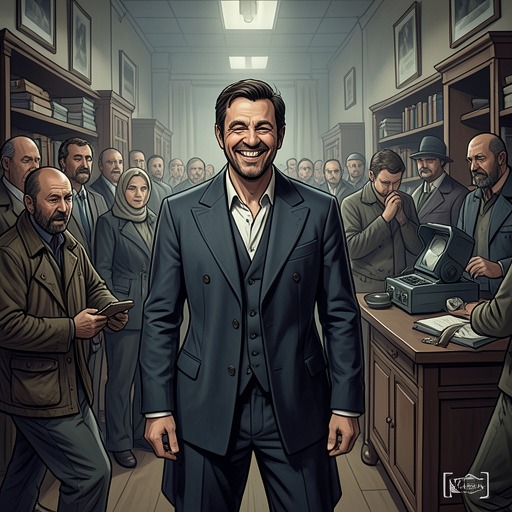
His appeal insists that the separation between rich and poor cannot make the powerful safe from the consequences of suffering below them. He compares society to a vessel in which a wreck cannot remain a disaster for only some passengers: the destruction of one part endangers the whole. The argument turns compassion into an appeal to self-preservation as well as justice. Yet the peers laugh. Their reaction repeats the divide already visible at the Green Box: Gwynplaine’s words express distress, while the appearance fixed on his face makes him seem comic to his audience.
The face as a political symbol
Gwynplaine answers the peers’ description of him as a monster by presenting himself as representative rather than exceptional. He connects the expression of laughter imposed on his face to a people made to appear content while enduring suffering. In his account, the face is a sign of enforced silence, rage, and despair; its apparent cheerfulness disguises the pain it cannot openly display. The comparison makes his bodily difference a political image, not a claim that the poor literally share his condition.
He warns that a hierarchy which appears solid may not remain so. The people’s suffering, he argues, contains the possibility of upheaval, and the public laughter directed at him cannot disprove the grievance he voices. The speech thus brings the novel’s two recurring audiences into collision: poor spectators who pay for a brief escape, and powerful listeners who treat an indictment as entertainment. English class inequality is exposed not only by the unequal distribution of wealth, work, and protection, but by the unequal authority to define what suffering means. Gwynplaine can make the poor forget for a moment; before the peers, he tries to make them see. Their laughter leaves that appeal unheard, even as it confirms the distance he has described.